


There is no magic system that guarantees profits in football betting. Anyone who tells you otherwise is either lying or selling something. The sportsbooks employ teams of analysts, use sophisticated algorithms, and have been refining their craft for decades. They are not in the business of giving money away. That said, the gap between recreational bettors who lose consistently and sharp bettors who grind out profits is not luck. It is approach.
The strategies in this guide will not turn you into a millionaire overnight. What they will do is tilt the odds slightly more in your favor, reduce the mistakes that drain bankrolls, and help you think about betting as a disciplined practice rather than entertainment gambling. Small edges compound over hundreds of bets. A bettor who wins 53% against the spread instead of 48% will see dramatically different long-term results despite the seemingly minor difference.
Profitable football betting requires three things: sound bankroll management, rigorous research habits, and the emotional discipline to stick with your process through losing streaks. Most bettors fail at least one of these. Many fail all three. The strategies here address each component so you can build a sustainable approach that survives the variance inherent in any form of sports wagering.
Fundamentals of Football Bankroll Management

Bankroll management is the least exciting aspect of betting and the most important. You can have the sharpest picks in the world, but if you bet recklessly, you will eventually go broke. Variance is real. Even winning bettors experience brutal losing streaks that would wipe out anyone who sizes their bets poorly. No betting system can survive long-term without strict football bankroll management strategies to protect your capital during inevitable losing streaks.
Setting Your Betting Budget
Your bankroll should be money you can afford to lose completely. This is not your rent money, your emergency fund, or anything you might need for actual life expenses. It is discretionary entertainment money that you have consciously decided to allocate to sports betting. If losing your entire bankroll would cause financial stress, you are betting with money you cannot afford to lose.
Once you establish that number, treat it as a fixed amount for a defined period. Many bettors fund their accounts monthly or seasonally. The key is psychological separation. When that money enters your sportsbook account, it is no longer your bank account money. It is your betting bankroll, and it follows its own rules.
Realistic bankroll sizing depends on your goals. A recreational bettor might start with $500 and accept that it could be gone by December. A more serious bettor building toward long-term profitability might start with $2,000-5,000 and expect to grind slowly. The amount matters less than the commitment to treating it with discipline.
Unit Sizing Strategies
A unit is a standardized bet size representing a percentage of your bankroll. Most professional bettors use 1-3% of their bankroll as a single unit. If your bankroll is $1,000, one unit is $10-30. This standardization does two things: it prevents emotional bet sizing, and it ensures you can survive losing streaks without going broke.
The conservative approach uses flat betting at one unit per wager. Every bet is the same size regardless of confidence level. This approach minimizes risk and is recommended for beginners. You will never blow up your bankroll on a “sure thing” that turns out to be nothing of the sort.
More aggressive bettors use variable unit sizing based on perceived edge. A standard play might be one unit, a strong play two units, and a rare high-confidence play three units. The danger here is overconfidence. If you find yourself making three-unit plays frequently, you are fooling yourself about your edge. True high-confidence opportunities are rare.
The Kelly Criterion Simplified
The Kelly Criterion is a mathematical formula for optimal bet sizing based on your edge and the odds offered. In theory, it maximizes long-term bankroll growth. In practice, full Kelly betting is too aggressive for most bettors because it assumes you know your true edge precisely, which you almost certainly do not.
The formula is: Kelly % = (bp – q) / b, where b is the decimal odds minus 1, p is your probability of winning, and q is your probability of losing (1 – p). If you believe you have a 55% chance of winning a bet at -110 odds (decimal 1.91), the Kelly percentage would be around 5.5% of your bankroll.
Most sharp bettors use fractional Kelly, typically one-quarter to one-half of the calculated amount. This reduces variance while still capturing most of the growth benefits. If full Kelly says bet 5%, half Kelly says bet 2.5%. This more conservative approach accounts for the uncertainty in your edge estimates and helps you survive the inevitable estimation errors.
When to Adjust Bet Sizes
Your unit size should scale with your bankroll over time. If you start with $1,000 and grow to $2,000, your unit should increase proportionally. Conversely, if you drop to $500, your unit should decrease. This keeps your risk exposure consistent as a percentage of your current bankroll.
Resist the temptation to chase losses with larger bets. This is the fastest path to bankruptcy in sports betting. A bad week does not mean you should increase stakes to recover quickly. It means you should continue with your standard approach and let the math work over time. Similarly, a hot streak does not justify abandoning discipline. Stay the course.
Line Shopping Strategy
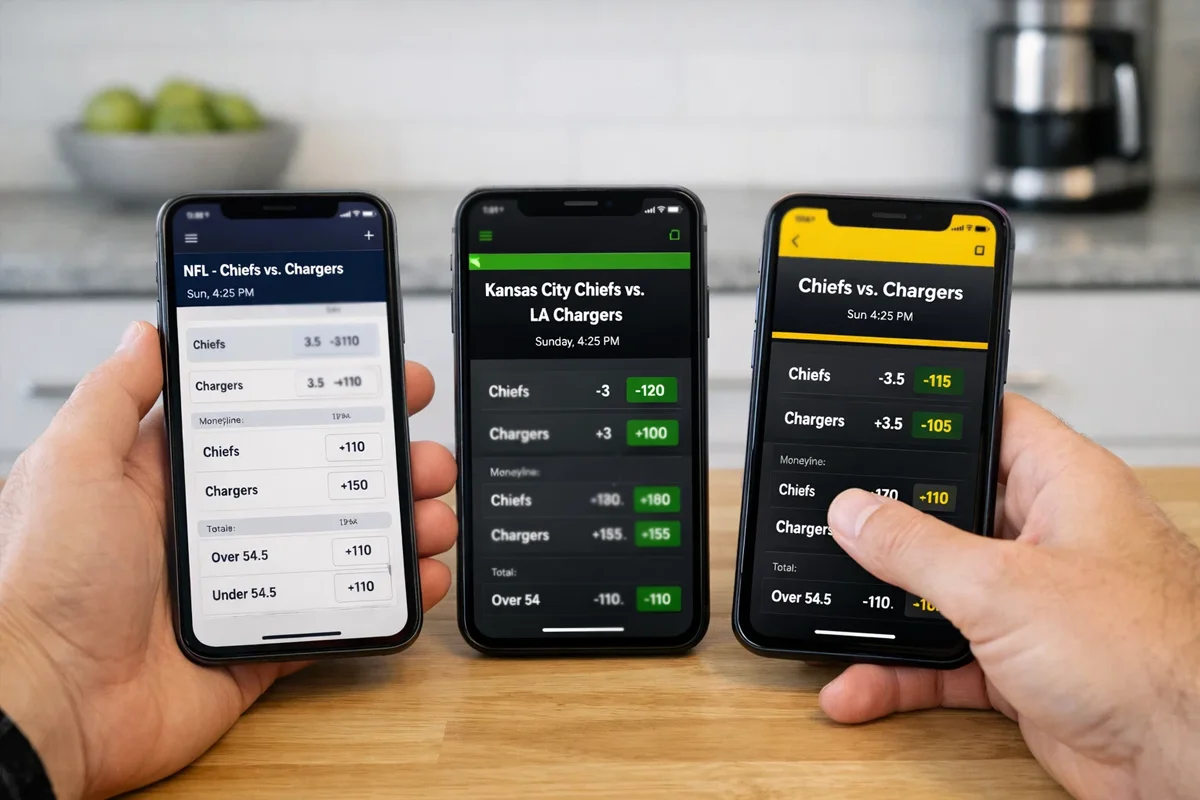
Line shopping is the practice of comparing odds across multiple sportsbooks to find the best available number for your bet. It requires almost no additional effort once you have accounts set up, yet most recreational bettors ignore it entirely.
Why It Matters
The difference between betting at -110 and -105 might seem trivial on any single wager. Over hundreds of bets, it represents a massive swing in expected value. A bettor placing 500 bets per year at an average of $50 per bet saves roughly $500 annually just by consistently getting -105 instead of -110.
Point spread differences matter even more. Getting +3.5 instead of +3 on an NFL underdog changes your win probability meaningfully given how often games land on exactly 3 points. The bettor who always grabs the best number will outperform the bettor who blindly bets at one sportsbook.
Having Multiple Accounts
You need accounts at a minimum of three to four major sportsbooks to shop lines effectively. The setup process takes an afternoon. Once established, checking multiple apps before placing a bet becomes second nature.
Different sportsbooks have different strengths. One might consistently offer better NFL spreads while another has sharper props lines. The only downside is managing funds across platforms. Keep reasonable balances at each location or be prepared to move money periodically.
Real-World Savings Examples
Consider a Sunday slate where you want to bet the Packers -3. You check four sportsbooks: DraftKings has -3 (-110), FanDuel has -3 (-115), BetMGM has -3.5 (-110), and Caesars has -3 (-105). The obvious choice is Caesars at -105. These decisions add up. A disciplined line shopper making slightly better choices on 200 bets per season ends the year with hundreds of dollars more than someone who never bothered to look around.
Research-Based Handicapping
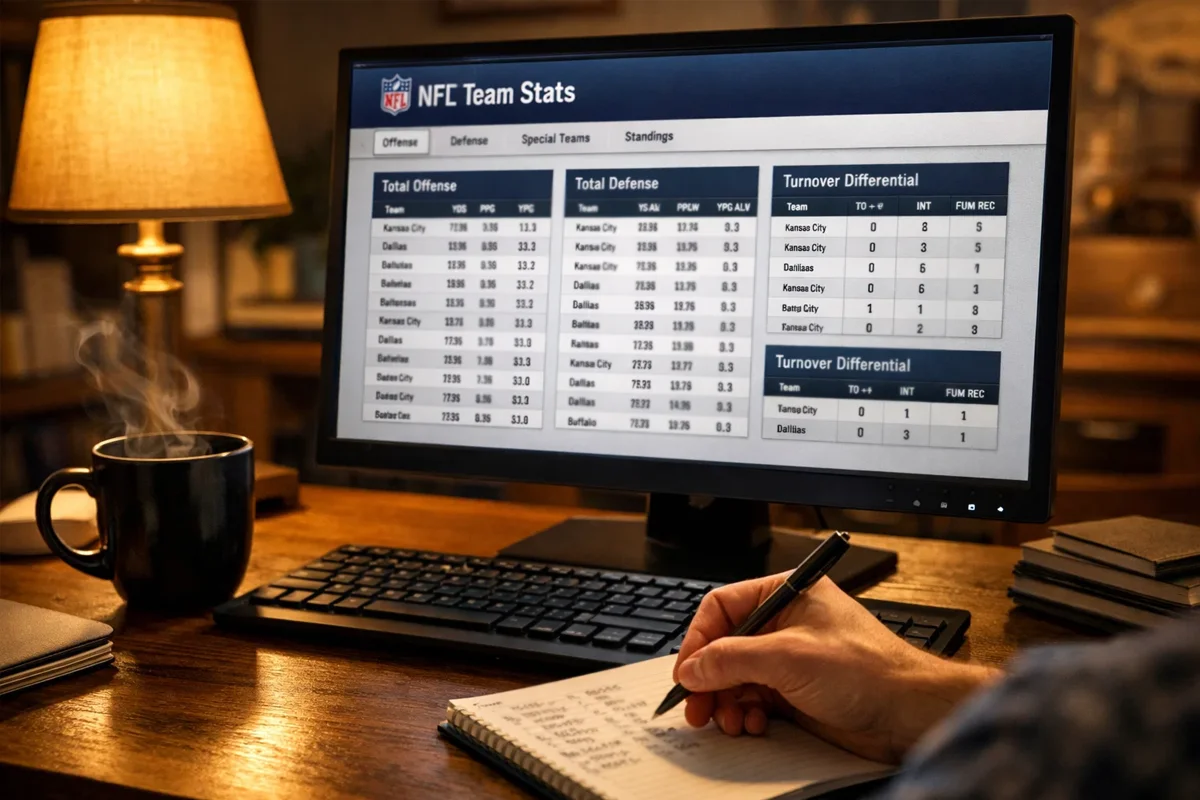
Handicapping is the process of analyzing matchups to identify betting opportunities. The goal is to form your own probability estimates for game outcomes and compare them to what the market implies. When your estimate differs significantly from the market, you have a potential bet.
Key Statistics to Analyze
Not all statistics are equally useful for predicting football outcomes. Win-loss records tell you what happened but not why. Point differential is better because it captures margin of victory. But even point differential can be skewed by garbage time scoring or fluky special teams plays.
Focus on efficiency metrics that measure how well teams move the ball and prevent movement. Yards per play, success rate on early downs, and third-down conversion rates reveal more about team quality than total yardage. Scoring in the red zone matters too; some teams consistently punch it in while others settle for field goals.
Turnover differential is famously volatile year over year. A team that led the league in takeaways last season probably benefited from luck as much as skill. Regression toward the mean is real. Be skeptical of teams whose records were built on unsustainable turnover margins.
Advanced Metrics Worth Knowing
DVOA (Defense-adjusted Value Over Average) from Football Outsiders measures team efficiency on every play adjusted for opponent quality and game situation. It separates genuine performance from schedule-based noise better than raw stats. Teams with high DVOA and mediocre records often offer value as the market catches up.
EPA (Expected Points Added) quantifies how much each play improved or hurt a team’s expected scoring. Aggregated over a season, EPA per play is one of the best predictors of future performance. Quarterbacks are often evaluated using EPA because it captures their contributions better than traditional stats like yards or touchdowns.
Success rate measures how often a team achieves positive expected points on a play. High-success-rate offenses convert steadily without relying on explosive plays. This consistency is valuable for predicting spread outcomes where margins matter.
Injury Impact Analysis
Injuries are the great equalizer in football betting. A team missing their starting quarterback is fundamentally different from the team with their full roster. The market adjusts for major injuries, but the adjustment is not always accurate. Your edge comes from evaluating injury impact better than the consensus.
Quarterback injuries have the largest and most predictable impact. The drop from a top-10 quarterback to an average backup is worth 3-7 points depending on the players involved. Offensive line injuries are underrated; missing a starting tackle affects every passing and running play. Defensive injuries matter less individually but accumulate quickly when multiple starters are out.
Monitor injury reports throughout the week. Wednesday reports are preliminary; Friday and Saturday updates reveal who will actually play. Be prepared to bet early if you think the market will move against you once injury news becomes widely known, or wait if you expect favorable movement.
Weather and Schedule Spot Analysis
Weather affects outdoor games in predictable ways. Wind over 15 mph suppresses passing and kicking, pushing totals lower and favoring teams with strong running games. Rain and snow compound the effect. Cold temperatures have less impact than many assume, but extreme cold combined with wind creates difficult conditions.
Schedule spots refer to situational advantages or disadvantages based on rest, travel, and upcoming opponents. A team playing on a short week after a physical divisional game is at a disadvantage. A team with a bye week typically outperforms the market. Lookahead spots, where a team faces a weak opponent before a major rivalry game, can cause letdowns.
These factors are priced into the market, but not always efficiently. When multiple situational factors align, the cumulative effect sometimes exceeds what the line reflects.
Value Betting Approach
Value betting is the core concept separating profitable bettors from losing ones. A value bet exists when the probability of an outcome is higher than what the odds imply.
Identifying Value
To identify value, you must first estimate the true probability of each outcome. If you think the Cowboys have a 55% chance to cover the spread, write that down. At -110 odds, the implied probability is about 52.4%. The gap between 55% and 52.4% represents your edge. That 2.6% edge, applied consistently over many bets, produces long-term profit.
Most bettors overestimate their ability to predict outcomes. Vague confidence is not an edge. Disciplined value bettors force themselves to assign probabilities even when it feels arbitrary. Over time, you can calibrate your estimates by tracking predictions against actual results.
Comparing Your Odds to the Market
The betting market is surprisingly efficient. By game time, most spreads and totals are close to accurate representations of true probability. Where does the average bettor find edge? Usually in spots the market underweights: small-market teams, early-week lines before sharp money arrives, specific game situations that algorithms might miss.
The humbling reality is that most bettors have zero edge most of the time. The correct action is often to not bet. Passing on a game because you cannot find value is discipline, not weakness.
Long-Term Perspective
Value betting only works over large sample sizes. A single bet is essentially a coin flip with slight bias. The edge reveals itself over hundreds of bets. This means you must accept losing streaks as inevitable. A bettor with a true 54% win rate will experience week-long losing stretches regularly.
Track your bets meticulously and evaluate results over seasons, not weeks. The yearly number is what matters, and even that can be negative occasionally due to variance.
Specific Football Strategies
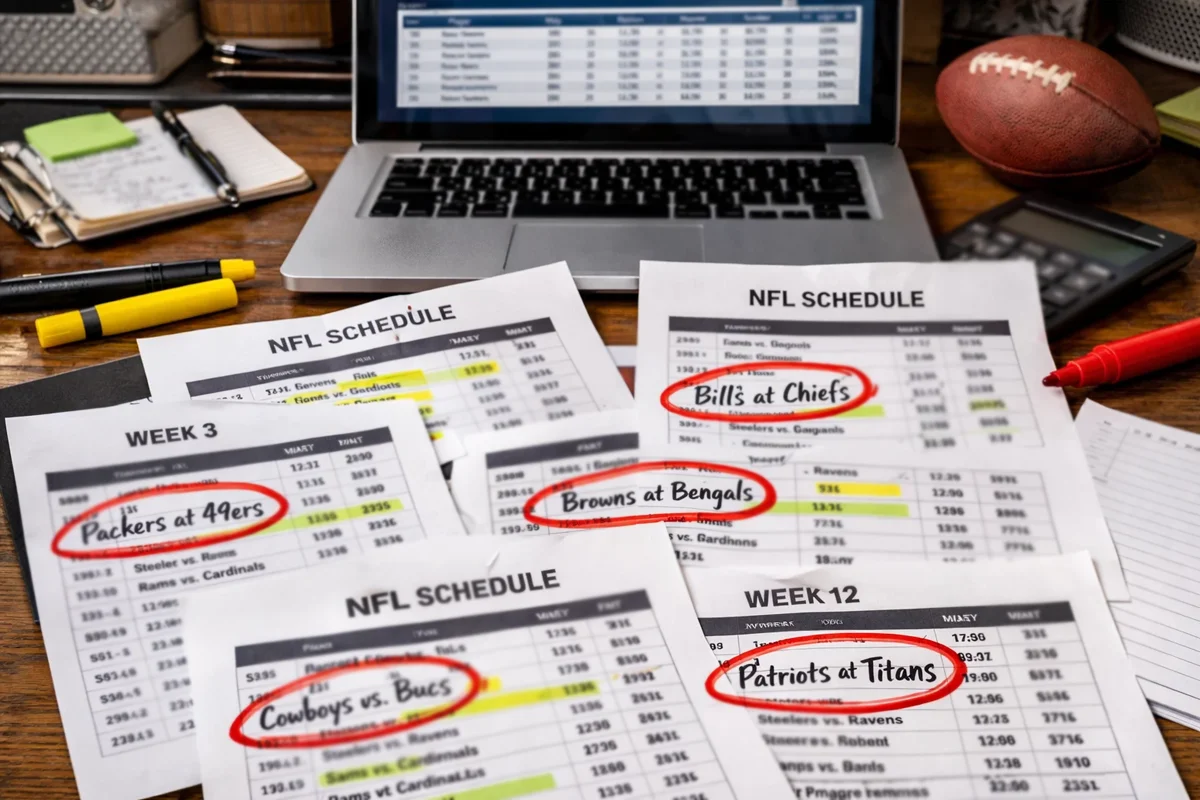
Beyond general principles, certain football-specific strategies have shown historical profitability. These are not guarantees, as the market adapts to known edges, but they provide starting points for your own analysis.
Betting Underdogs Against the Spread
Historically, NFL underdogs have covered the spread at rates slightly above 50%. The effect is more pronounced for large underdogs of 7 or more points. The market tends to overvalue favorites because public money flows toward winners, and sportsbooks shade lines to balance action.
This does not mean blindly betting every underdog. The edge is small and has narrowed as the market has become more efficient. Look for underdogs in specific situations: home underdogs, divisional underdogs, and underdogs coming off bye weeks. These subsets have shown stronger historical performance than underdogs generally.
Be cautious with underdogs on the moneyline. The ATS edge does not necessarily translate to outright winning. A team that consistently loses by a field goal covers spreads but rarely wins games. Understand what your data actually shows before extrapolating.
Divisional Game Trends
Divisional games play differently than non-divisional matchups. Teams know each other well, reducing schematic advantages. Home field matters more when fanbases have genuine rivals in the building. Motivation fluctuates less because divisional standings are always relevant.
The historical trend shows underdogs performing slightly better in divisional games. The familiarity factor compresses margins, leading to tighter results than the pregame spread suggests. Heavy divisional favorites of 7+ points cover less often than expected.
Late-season divisional games between eliminated teams and playoff contenders can produce unusual results. The eliminated team has nothing to lose and sometimes plays spoiler. Meanwhile, the contender might be looking ahead or resting starters. These situational angles are worth monitoring.
Primetime Game Considerations
Monday Night Football, Sunday Night Football, and Thursday Night Football attract the most public attention. The lines are sharper because more money flows in and sportsbooks invest more effort in setting them. Finding value on primetime games is harder than on Sunday afternoon.
Thursday games in particular create opportunities. Teams on short rest perform poorly, especially the road team that traveled. If both teams had Sunday games, the home team holds a significant rest advantage. Historical data shows road teams on Thursday night underperforming the spread.
The public loves primetime favorites. When a popular team plays under the lights, casual money hammers them. This can push the line past fair value, creating contrarian opportunities on the underdog. Fading public sentiment in high-profile spots has historically shown modest returns.
Sharp vs Public Money
Understanding who is betting which side can inform your decisions. Sharp money comes from professional bettors with established track records. Public money comes from recreational bettors who bet casually without sophisticated analysis.
Reverse line movement signals sharp action. If 70% of bets are on the Cowboys but the line moves from Cowboys -3 to Cowboys -2.5, sharps are likely on the other side. The smaller volume of sharp money outweighs the larger volume of public bets because sportsbooks respect sharp opinions.
Following sharp money blindly is not a strategy. By the time you notice the move, the value may be gone. But understanding where sharps and squares typically land helps you evaluate your own positions. If you find yourself consistently on the public side of lopsided betting percentages, examine whether you are falling into recreational bettor patterns.
Common Mistakes to Avoid
Knowing what not to do is as important as knowing what to do. Most bettors lose because of repeated mistakes they could eliminate with awareness and discipline.
Emotional Betting on Your Team
Betting on your favorite team is usually a mistake. Fandom clouds judgment. You overestimate their chances, rationalize their weaknesses, and feel every loss twice. If you insist on betting your team, apply extra scrutiny. Would you bet this line if it were any other team? If the answer is no, skip it.
The same logic applies to rivalries. Betting against your hated rival because you want them to lose is not analysis. Your spite is not an edge.
Chasing Losses
After a losing day, the temptation to increase bet sizes to recover quickly is powerful. This is the single fastest way to destroy a bankroll. You are not “due” for a win. The next bet has the same probability regardless of your recent results.
Chasing losses compounds the problem. Larger bets mean larger potential losses, which create even more pressure to chase. If you find yourself increasing bet sizes after losses, step away. Take a day or a week off.
Overreacting to Single Games
One game does not define a team’s quality. Upsets happen every week. A blowout loss might reflect injuries, bad luck, or an opponent’s exceptional day. The market often overreacts to recent results; you should not compound that error.
Regression to the mean is your friend. Teams that massively overperform or underperform expectations tend to normalize over time.
Taking Bad Numbers
Betting the wrong number because you acted too quickly or failed to shop lines is a self-inflicted wound. If the line has moved against you since you started considering the bet, reevaluate whether value still exists.
Never bet a stale opinion. If you decided to bet the Chiefs -3 on Tuesday but the line is now Chiefs -4.5, your original analysis no longer applies. Reconsider whether the bet makes sense at the current number.
Record Keeping and Analysis
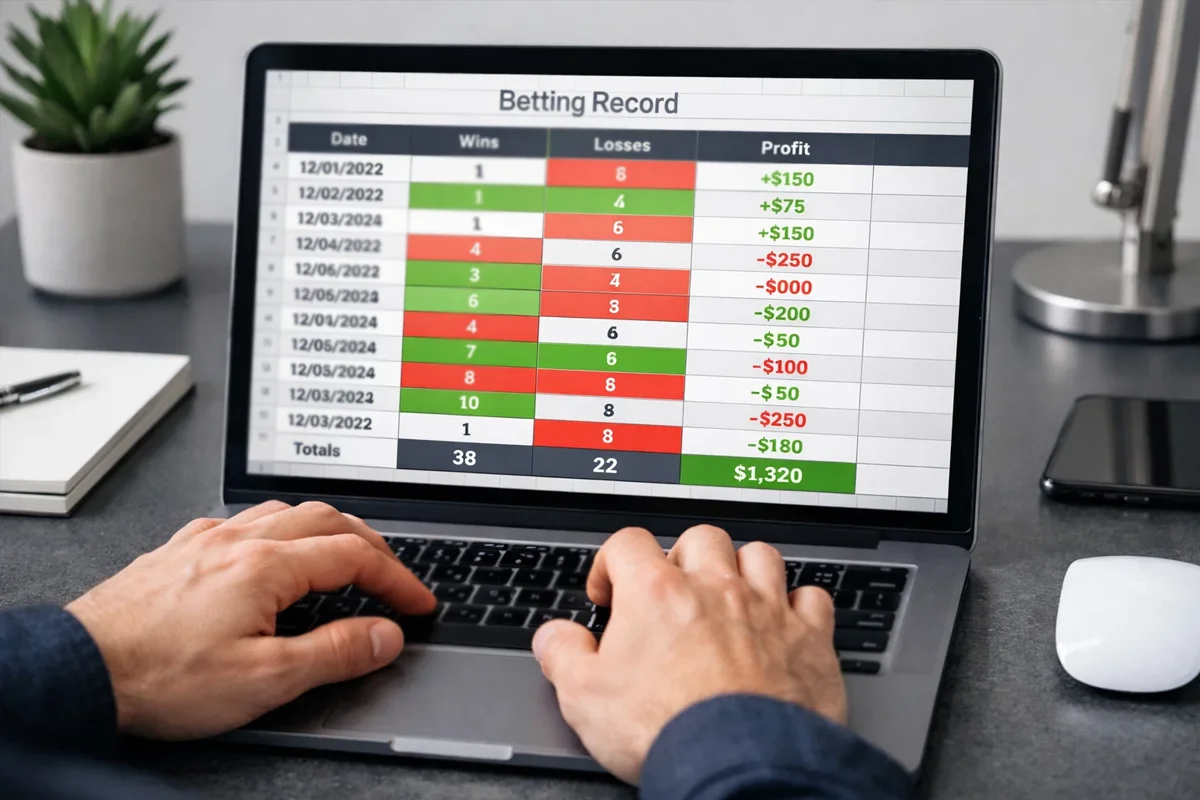
You cannot improve what you do not measure. Tracking your bets systematically is essential for identifying strengths, weaknesses, and patterns.
Why Tracking Matters
Memory is unreliable. Bettors consistently overestimate their win rates and forget losing bets faster than winners. Without records, you cannot know whether your approach is actually profitable. Long-term tracking separates signal from noise. A 10-bet sample tells you nothing; a 500-bet sample reveals your true performance.
What to Record
At minimum, record the date, bet type, team, odds, stake, and result. More detailed tracking includes your confidence level, the closing line, and notes about why you made the bet. Closing line value is particularly useful: if you bet a team at -3 and the line closes at -4, you got a better number than the market settled on.
Use a spreadsheet or dedicated tracking app. Update records immediately after placing bets and after results come in.
Analyzing Your Results
Review your results monthly and seasonally. Look for patterns by bet type, sport, and stake size. Be honest with yourself. If the data shows you have no edge, accept it. Use your analysis to refine strategy: if your totals perform well but props underperform, consider focusing more on totals.
Conclusion
Profitable football betting is not about finding a secret system. It is about executing a disciplined process better than the average bettor. Manage your bankroll conservatively. Shop for the best lines. Research matchups using meaningful statistics. Bet only when you find genuine value. Avoid emotional mistakes. Track everything and learn from your results.
Most people who read this guide will not implement it fully. They will continue betting impulsively, chasing losses, and ignoring line shopping because discipline is harder than excitement. That is fine. Their losses fund the sportsbooks and the small percentage of bettors who take the craft seriously.
If you want to be in that small percentage, start today. Open multiple sportsbook accounts. Build a tracking spreadsheet. Define your bankroll and unit sizes. Commit to the process for a full season before evaluating results. The edge is small and the path is long, but it exists for those willing to walk it.
Apply these proven tactical approaches at the best online football sportsbooks to ensure your funds are secure and your payouts are fast.
