Understanding betting odds is the single most important skill any football bettor can develop. Without this foundation, you are essentially throwing money at a screen and hoping for the best. Odds tell you everything you need to know about a bet: how much you can win, what the sportsbook thinks about each team, and whether you are getting a fair deal. The problem is that odds look intimidating at first glance. A line reading Chiefs -155 or Eagles +130 means nothing to someone who has never placed a bet before.
This guide breaks down every odds format you will encounter when betting on NFL and college football. By the time you finish reading, you will know how to calculate your potential payout in seconds, convert between American, decimal, and fractional odds, and spot when a sportsbook is offering you genuine value versus when they are taking you for a ride. The math is simpler than it looks, and once it clicks, you will wonder why you ever found it confusing.
Whether you are betting your first game this Sunday or trying to sharpen your existing knowledge, understanding odds transforms you from a casual gambler into someone who makes informed decisions. That shift in mindset is worth more than any betting tip or system someone might try to sell you.
Understanding the Mechanics of Betting Odds
Betting odds serve two essential purposes in sports wagering. First, they communicate the probability of an event occurring, at least as the sportsbook sees it. Second, they determine how much money you will receive if your bet wins. These two functions are mathematically linked, and understanding that relationship is key to becoming a smarter bettor.
When a sportsbook posts odds on a football game, they are making a statement about who they expect to win and by how much. If the Buffalo Bills are listed as heavy favorites over the New England Patriots, the odds will reflect that. You will win less money betting on Buffalo because the outcome is considered more likely. Conversely, betting on New England pays more because their victory is seen as less probable. This is not the sportsbook being generous; it is basic risk-and-reward math.
Bookmakers do not set odds based purely on their own opinions about who will win. They employ teams of analysts and use sophisticated algorithms, but the lines also respond to betting action from the public. When lots of money comes in on one side, the odds shift to balance the book. This means the opening line you see Monday morning might look very different by Sunday kickoff. Understanding that odds are dynamic, not static, helps you recognize good opportunities when they appear.
The critical concept to grasp is that odds are not a perfect reflection of true probability. Sportsbooks build in a margin called the vig, vigorish, or juice. This is their profit mechanism. A truly fair bet on a coin flip would offer even money on both sides. Instead, you typically see something like -110 on each outcome, meaning you must risk $110 to win $100. That extra $10 is where the sportsbook makes its money. Recognizing this built-in edge is the first step toward betting with your eyes open.
American Odds In-Depth
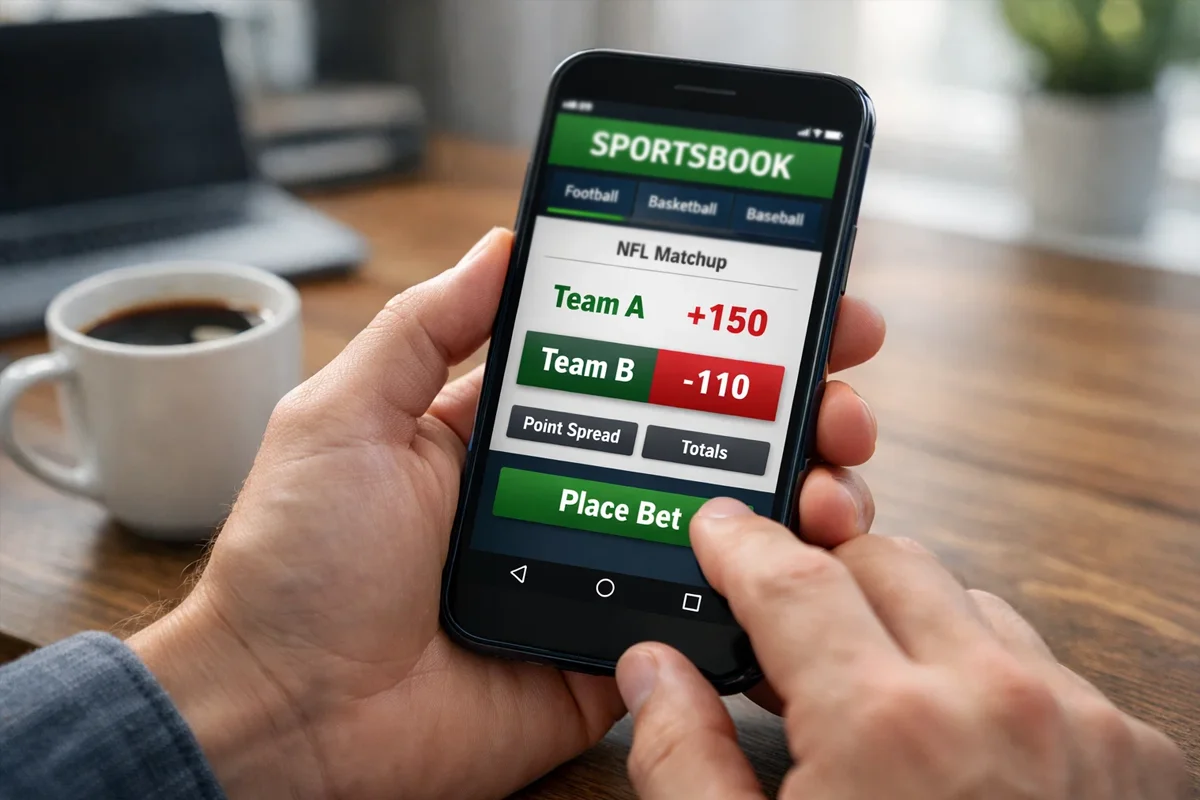
American odds are the standard format at every major US sportsbook. You will see them displayed with either a plus sign or a minus sign followed by a number. The sign tells you whether you are looking at the favorite or the underdog, and the number tells you how much you stand to win or need to risk.
Understanding Negative Odds
Negative odds indicate the favorite in a matchup. The number tells you how much money you must bet to win $100 in profit. If the Kansas City Chiefs are listed at -175 against the Las Vegas Raiders, you would need to wager $175 to profit $100 if the Chiefs win. Your total return would be $275: your original $175 stake plus your $100 in winnings.
The larger the negative number, the heavier the favorite. A team at -300 is a bigger favorite than a team at -150. At -300, you are risking $300 to win just $100. This ratio reflects the sportsbook’s confidence that the outcome is likely. They are not going to pay you much for correctly predicting something they consider nearly certain.
To calculate your exact payout on negative odds, divide 100 by the odds number (ignoring the minus sign), then multiply by your stake. For a $50 bet at -175: divide 100 by 175 to get 0.571, then multiply by 50 to get $28.57 in potential profit. Your total return would be $78.57. Modern sportsbook apps do this math automatically on your bet slip, but understanding the calculation helps you think about value.
Understanding Positive Odds
Positive odds indicate the underdog. The number tells you how much profit you will receive on a $100 wager. If the Jacksonville Jaguars are listed at +210 against the Miami Dolphins, a $100 bet on Jacksonville would return $210 in profit if they win outright. Your total payout would be $310: your original $100 plus your $210 winnings.
The larger the positive number, the bigger the underdog. A team at +400 is considered less likely to win than a team at +150. That +400 line means the sportsbook is offering four-to-one odds on what they view as an unlikely outcome. When these longshots do hit, they pay handsomely.
The payout calculation for positive odds is straightforward. Divide the odds by 100, then multiply by your stake. For a $50 bet at +210: divide 210 by 100 to get 2.1, then multiply by 50 to get $105 in potential profit. Your total return would be $155. Again, your betting app handles this automatically, but the mental math becomes second nature with practice.
Real NFL Game Examples
Consider a Week 12 matchup between the Philadelphia Eagles and Dallas Cowboys. The sportsbook posts the following moneyline odds: Eagles -145, Cowboys +125. What does this tell you? Philadelphia is the favorite. Betting $145 on the Eagles returns $100 profit if they win. Betting $100 on Dallas returns $125 profit if the Cowboys pull off the upset.
Now look at a more lopsided game. The San Francisco 49ers host the Carolina Panthers with odds of 49ers -350, Panthers +275. San Francisco is a substantial favorite. You would need to risk $350 just to win $100 on the Niners. Meanwhile, that same $100 on Carolina returns $275 if they somehow win in Santa Clara. The massive gap between these numbers reflects how differently the sportsbook views each team’s chances.
Point spread bets typically show odds closer to even, usually around -110 on both sides. This is because the spread is designed to create a roughly equal betting proposition. When you see Packers -6.5 (-110) versus Bears +6.5 (-110), both sides require a $110 bet to win $100. The spread itself creates the balance; the odds just determine the payout.
Decimal Odds Explained
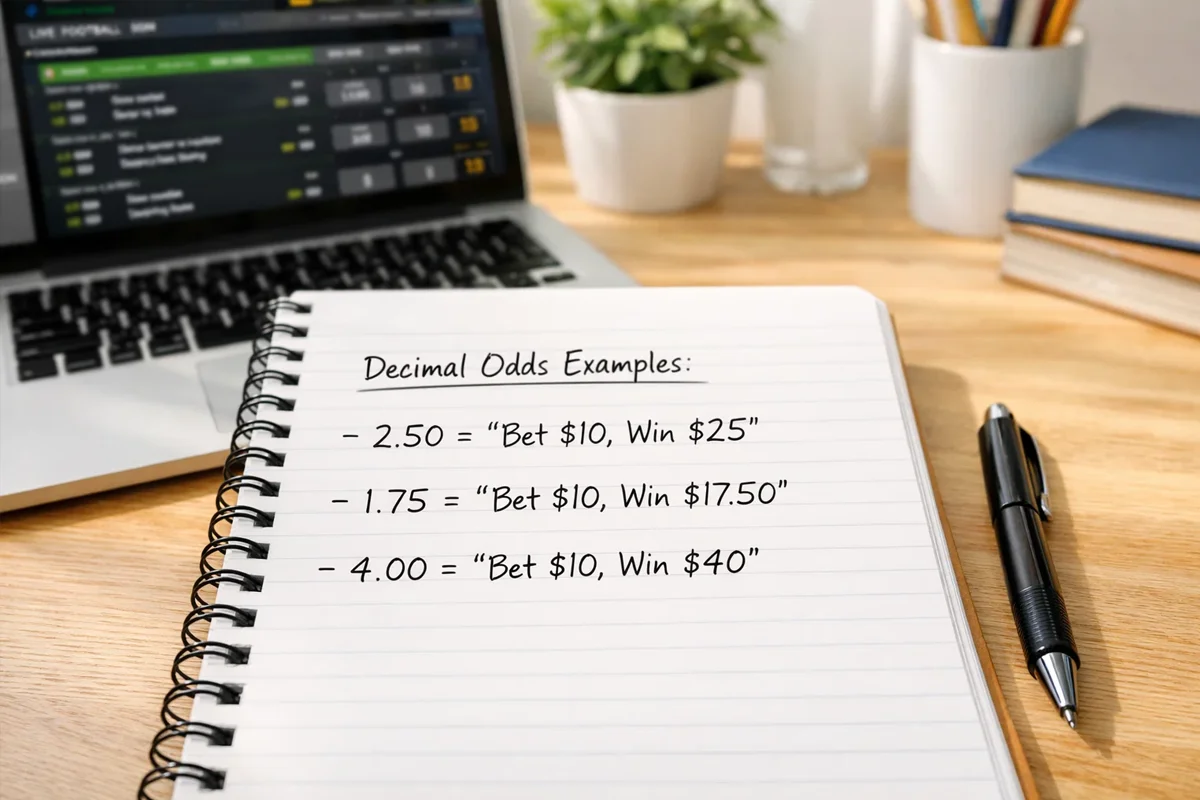
Decimal odds are the global standard outside North America. If you use international betting exchanges or follow European coverage of NFL games, you will encounter this format constantly. Many experienced bettors actually prefer decimal odds because they make payout calculations simpler and comparison shopping easier.
Decimal odds represent your total return on a successful $1 bet, including your original stake. An odd of 2.50 means a $1 bet returns $2.50 total: your $1 back plus $1.50 in profit. To find your total potential return on any bet, simply multiply your stake by the decimal odds. A $75 bet at 2.50 odds returns $187.50 total ($75 x 2.50).
The math simplicity becomes apparent when comparing bets. Which is better: American odds of +135 or decimal odds of 2.30? Converting +135 to decimal gives you 2.35 (formula: positive American odds divided by 100, plus 1). So +135 American equals 2.35 decimal, which is slightly better than 2.30. This instant comparison is why many sharp bettors toggle their sportsbook displays to decimal format.
Favorites in decimal odds are represented by numbers below 2.00. A -200 American favorite converts to 1.50 decimal. You can immediately see that a successful $100 bet returns just $150 total. Underdogs show as numbers above 2.00. That +275 underdog converts to 3.75 decimal, meaning a $100 bet returns $375 total. The conversion formula for negative American odds is: divide 100 by the absolute value of the odds, then add 1. For -200: 100/200 = 0.5, plus 1 = 1.50.
The decimal system originated in continental Europe and spread through international betting markets. Australia, Canada, and most of the non-UK world use decimal odds as their default. US sportsbooks universally offer a setting to switch between American and decimal displays, so you can use whichever format feels more natural.
Fractional Odds Explained
Fractional odds are the traditional British format, still dominant in UK betting shops and horse racing worldwide. While less common for American football betting, you will encounter them on certain international platforms and in historical betting literature. The format looks like a fraction: 5/1, 7/2, 11/8.
Reading fractional odds is intuitive once you understand the pattern. The first number represents potential profit; the second represents the stake required to win that profit. Odds of 5/1 (spoken as “five to one”) mean you profit $5 for every $1 wagered. A $100 bet at 5/1 returns $500 profit plus your $100 stake, totaling $600.
Fractions that do not reduce to simple ratios can look confusing. Odds of 11/8 mean you profit $11 for every $8 wagered. To calculate a payout: divide the first number by the second, then multiply by your stake. For $50 at 11/8: 11 divided by 8 equals 1.375, times 50 equals $68.75 profit. Your total return is $118.75.
Converting fractional odds to decimal is straightforward. Divide the first number by the second, then add 1. Odds of 5/1 become 6.00 decimal (5/1 + 1). Odds of 11/8 become 2.375 decimal (11/8 + 1 = 1.375 + 1). Converting to American odds requires an extra step. For fractions greater than 1/1 (evens), multiply the decimal result minus 1 by 100 for positive American odds. For fractions less than 1/1, divide 100 by the decimal minus 1, then make it negative.
The fractional system persists in British sports culture partly through tradition and partly because certain odds look cleaner as fractions. Evens (1/1) is more elegant than +100 or 2.00. Long-shot odds of 10/1 feel more dramatic than +1000 or 11.00. For practical NFL betting purposes, you will rarely need fractional odds, but the ability to convert them keeps you flexible across different platforms.
Implied Probability Deep Dive
Every betting line contains an implied probability, which is the sportsbook’s estimation of the likelihood that outcome will occur. Converting odds to implied probability lets you compare the market’s view against your own analysis. When you believe something is more likely to happen than the odds suggest, you have found potential value.
Converting Odds to Probability
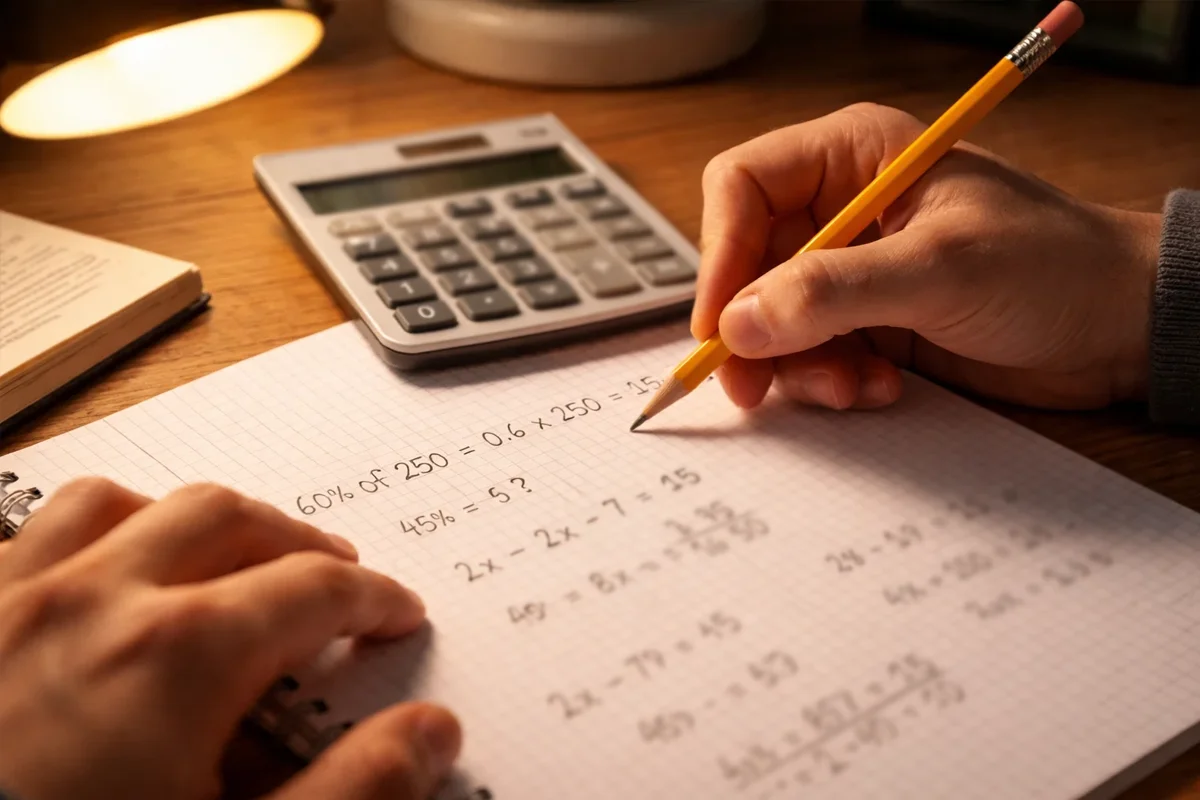
For negative American odds, the formula is: absolute value of the odds divided by (absolute value of the odds plus 100), then multiply by 100 to get a percentage. For -175 odds: 175/(175+100) = 175/275 = 0.636, or 63.6% implied probability. The sportsbook believes this outcome has roughly a 64% chance of happening.
For positive American odds, the formula is: 100 divided by (the odds plus 100), then multiply by 100. For +210 odds: 100/(210+100) = 100/310 = 0.323, or 32.3% implied probability. The sportsbook views this as about a one-in-three shot.
Decimal odds convert even more simply. Just divide 1 by the decimal odds and multiply by 100. For 2.50 decimal odds: 1/2.50 = 0.40, or 40% implied probability. For 1.50 decimal odds: 1/1.50 = 0.667, or 66.7% implied probability.
Understanding the Vig
Here is where things get interesting. If you add up the implied probabilities for all outcomes in a market, the total will exceed 100%. That overage is the vig. In a typical NFL game with spread betting at -110 on both sides, each side has an implied probability of 52.4% (110/210). Add them together: 52.4% + 52.4% = 104.8%. That extra 4.8% is the sportsbook’s built-in edge.
The vig varies by market and sportsbook. Some books offer reduced juice on NFL sides at -105 instead of -110, cutting the vig roughly in half. Prop bets and parlays typically carry higher vig, sometimes pushing total implied probability above 110%. Understanding where the vig is higher helps you focus your betting on markets where you are giving up less edge.
Finding Value Bets
A value bet exists when your estimated probability of an outcome exceeds the implied probability from the odds. Suppose the Detroit Lions are +180 underdogs against the Green Bay Packers. The implied probability is 35.7%. You analyze the matchup and believe Detroit actually has a 42% chance of winning. That gap between 42% and 35.7% represents potential value.
This does not mean your bet will win. The Lions could easily lose. But if your probability assessment is accurate and you consistently bet when your edge is positive, you will profit over time. This is the mathematical foundation of professional sports betting: finding and exploiting small edges across many bets.
The challenge is that estimating true probability is genuinely difficult. The sportsbook employs experts and has access to sophisticated models. Beating the market consistently requires either superior information or superior analysis. Most casual bettors overestimate their edge. But understanding implied probability at least ensures you are asking the right questions before placing a bet.
Odds Movement and What It Means

Betting lines are not fixed once they are posted. From the moment a line opens until game time, odds shift based on betting action, injury news, weather updates, and countless other factors. Learning to read these movements provides insight into where money is flowing and what sharps might be thinking.
Why Lines Move
The primary driver of line movement is betting volume. When significantly more money comes in on one side, the sportsbook adjusts odds to encourage action on the other side. If the public hammers the Kansas City Chiefs at -3, the line might move to Chiefs -3.5 or -4. This creates better value on the other side and helps the book balance their exposure.
News events trigger immediate movement. When a starting quarterback is ruled out, you will see the line react within minutes. Major injury announcements, particularly at quarterback, can move spreads by 2-3 points. Weather forecasts for outdoor games affect totals. A snow game projection might drop an over/under from 47 to 42. Tracking these movements helps you understand what information the market is pricing in.
Different sportsbooks move at different speeds and by different amounts. Offshore books that take larger limits from sharp bettors often move first. These “market-making” books set the tone, and retail sportsbooks follow. If you see a line move at Circa or Pinnacle, expect similar movement elsewhere within hours.
Sharp Action and Steam Moves
A steam move is a sudden, significant line change triggered by coordinated betting from sharp bettors or syndicates. The line might jump from -3 to -4 in minutes as multiple sportsbooks receive heavy action. Steam moves represent respected money entering the market, and many bettors try to follow or anticipate them.
Reverse line movement is the opposite phenomenon. This occurs when a line moves against the public betting percentage. If 75% of bets are on the Cowboys -7, but the line drops to Cowboys -6, sharp money is likely on the other side. The smaller volume of sharp bets outweighs the larger volume of public bets because sportsbooks respect the analytical edge that professionals bring.
Tracking line movement does not guarantee success. By the time you notice a move, the value may already be gone. But understanding why lines change helps you make better decisions about when to bet. Sometimes grabbing an early line is smart. Other times, waiting for movement toward your side creates better value. There is no universal rule; it depends on your read of the market.
Practical Odds Comparison
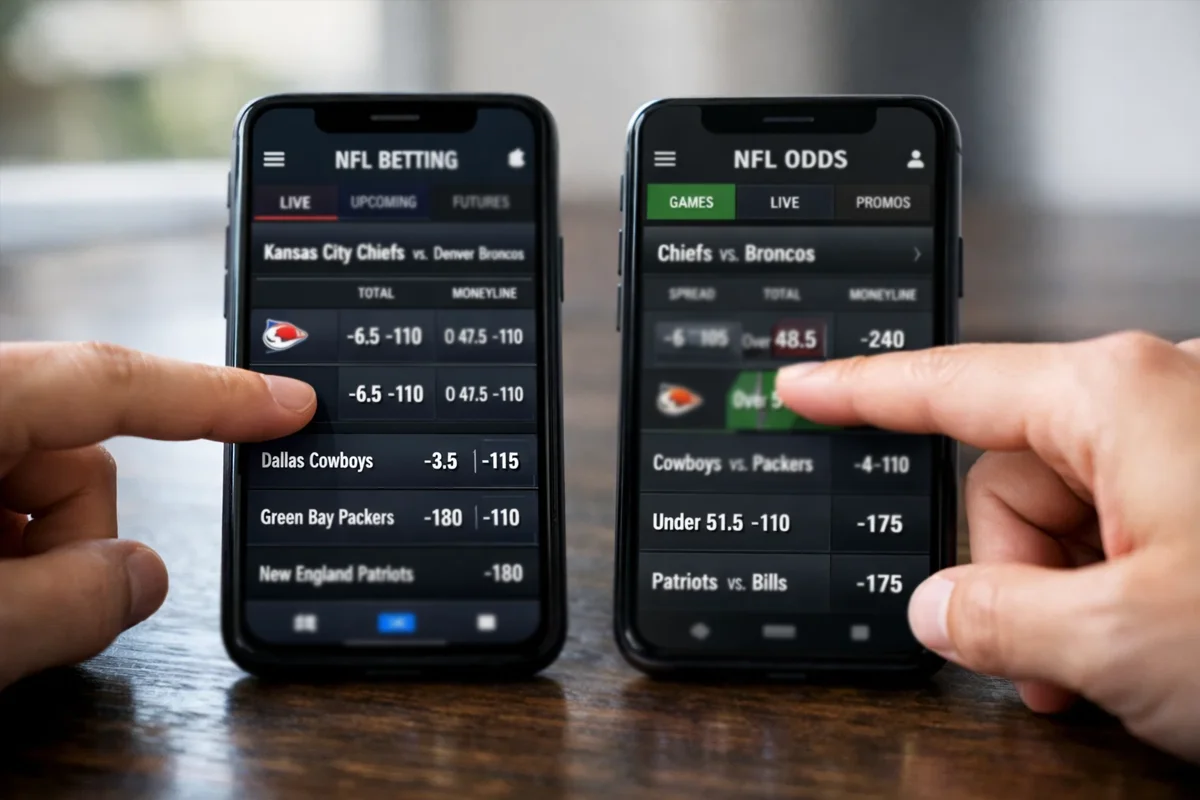
Shopping for the best odds is one of the few strategies that provides guaranteed long-term value. Different sportsbooks often post slightly different lines on the same game. Betting at -105 instead of -110 saves you money over time. Grabbing +130 instead of +125 increases your profits. These differences seem small but compound significantly over hundreds of bets.
Consider a sample NFL game where you want to bet the Minnesota Vikings on the moneyline. Here is what you might find across different books: DraftKings at +155, FanDuel at +150, BetMGM at +160, Caesars at +148. The spread is 12 points on this bet. A $100 wager returns $160 at BetMGM versus $148 at Caesars. That is $12 more profit for identical risk, just by clicking a different app.
Over a season of betting, these differences add up to meaningful money. Assume you place 200 bets averaging $50 each. If shopping for lines saves you just 2% on average, that is $200 back in your pocket. Some disciplined bettors save more. Having accounts at three to four major sportsbooks takes minimal effort and pays for itself almost immediately.
The variance between sportsbooks is especially pronounced on player props and game totals. These markets are less liquid and more prone to differing opinions. One book might post Patrick Mahomes over 285.5 passing yards at -115 while another has over 287.5 at -105. Knowing where to look for value on specific bet types separates profitable bettors from average ones.
Most sportsbook apps let you browse odds without placing a bet. Before locking in any wager, take 30 seconds to check the same line at two or three competing books. The habit takes almost no time and shifts expected value in your favor. It is the closest thing to a free lunch in sports betting.
Conclusion
Reading and calculating football betting odds is a skill that pays dividends forever once you learn it. American odds with their plus and minus signs, decimal odds with their simple multiplication, fractional odds with their traditional fractions: all three systems convey the same information in different formats. Knowing how to move between them keeps you flexible across any platform.
The deeper understanding comes from implied probability and line movement. When you can look at -145 and instantly think “about 59% implied probability,” you start evaluating bets differently. When you see a line move from -3 to -3.5 despite public money on the other side, you recognize sharp action. These reads take time to develop but become second nature with practice.
Take these calculations into your next betting decision. Before placing a wager, convert the odds to implied probability. Ask yourself whether you genuinely believe the true probability is higher than what the market implies. If the answer is yes, you have found a potential bet. If the answer is no or uncertain, there is no shame in passing. Understanding odds does not just help you win more. It helps you make decisions you can stand behind.
