

The NFL and college football might look like the same sport on the surface. Both involve 100 yards, four downs, and touchdowns worth six points. But from a betting perspective, these two markets operate so differently that strategies successful in one can fail spectacularly in the other. The bettor who treats them identically is leaving money on the table at best and making costly mistakes at worst.
The NFL offers 272 regular season games spread across 32 teams with parity engineered into the system. College football delivers over 60 FBS games per week during peak season across more than 130 FBS programs with talent gaps ranging from negligible to absurd. These structural differences ripple through every aspect of the betting markets: how lines are set, how they move, where inefficiencies hide, and which strategies actually work.
Understanding these differences is not optional for serious football bettors. The NFL commands the most betting handle of any sport in America, while college football Saturdays offer volume and variety that dwarf any single NFL Sunday. Bettors who can navigate both markets effectively double their opportunities for finding value. Those who cannot are fighting with one hand tied behind their back.
This guide breaks down the key differences between NFL and college football betting, explains why those differences exist, and provides strategic frameworks for attacking each market on its own terms.
Betting Market Differences: NFL vs College
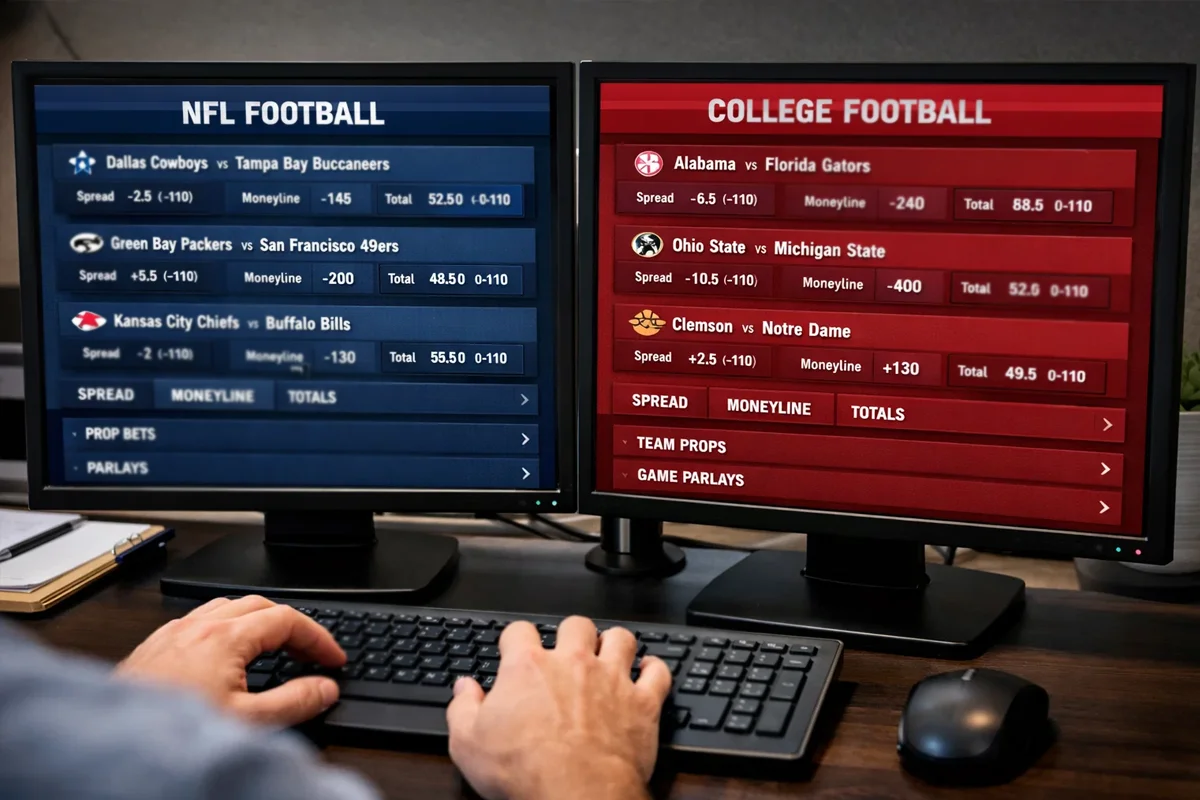
The fundamental structure of each league shapes everything in the betting markets. These are foundational differences that determine how oddsmakers approach their work and where bettors can find edges.
Number of Games and Volume
The NFL plays 17 games per team over 18 weeks. A typical Sunday features 13-14 games, with additional games on Thursday, Sunday night, and Monday night. Every single one receives intense scrutiny from bettors, media, and oddsmakers alike.
College football operates on a completely different scale. During a peak Saturday, more than 60 FBS games might kick off. The sheer volume means oddsmakers cannot devote equal attention to every matchup. A game between two mid-major programs receives a fraction of the analytical resources applied to a primetime NFL matchup.
Schedule Format and Information Availability
NFL schedules follow predictable patterns with parity engineered through draft order, salary caps, and scheduling formulas. This compresses talent differences and makes outcomes harder to predict.
College football schedules are chaotic. Teams play conference opponents plus a mix of non-conference games ranging from cupcake FCS opponents to neutral-site showcases. A team might face a bottom-tier opponent one week and a top-10 program the next.
NFL information flows freely through mandated injury reports, tracked practice participation, and extensive media coverage. The market absorbs information rapidly. College football information is fragmented, with inconsistent injury reporting and variable beat coverage. This asymmetry creates opportunities for bettors who invest in research.
Market Efficiency Comparison
The NFL is among the most efficient betting markets in the world. By game time, spreads are typically accurate within a point or two. College football markets are less efficient by necessity. Smaller programs receive less sharp attention, and public perception often lags reality.
Point Spread Differences
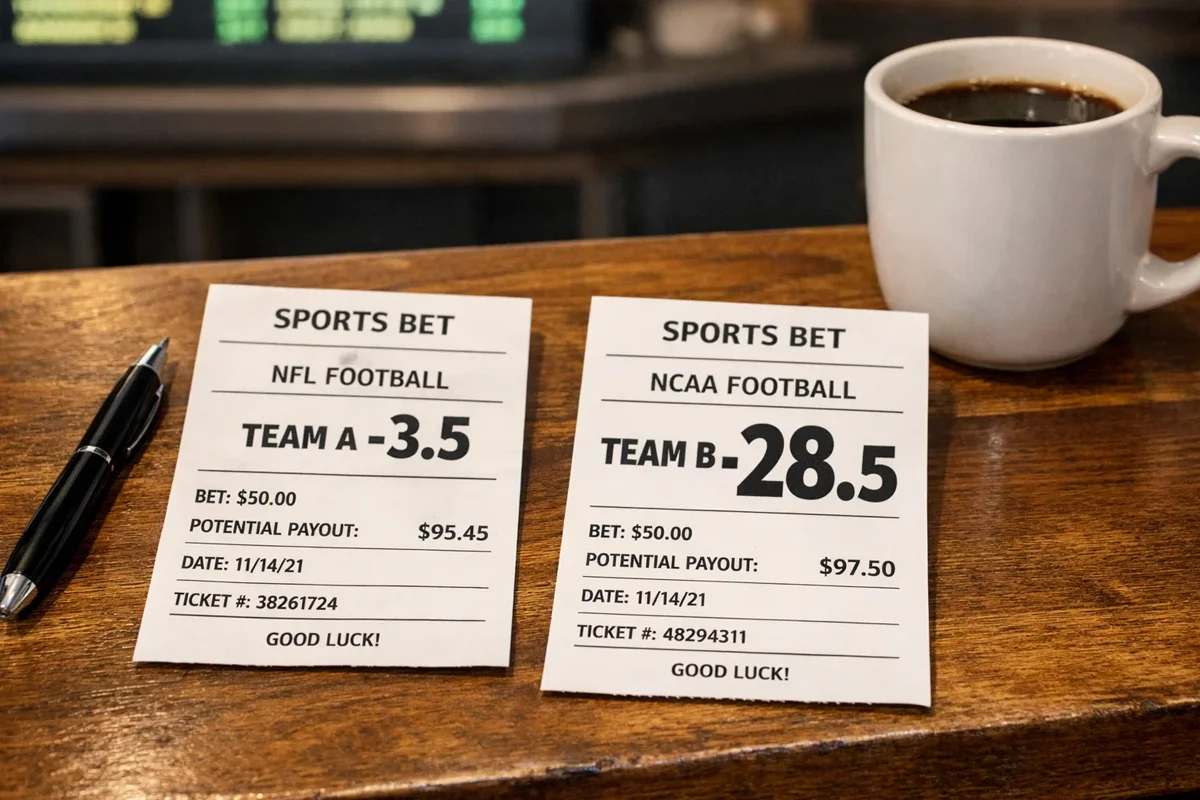
Point spreads in NFL and college football behave differently because the underlying competitive dynamics are different. Understanding these patterns helps bettors evaluate whether a spread represents value.
Average Spread Sizes
NFL spreads cluster tightly around small numbers. The average NFL spread hovers around 3-4 points, reflecting the league’s competitive balance. Spreads exceeding 10 points are rare; spreads above 14 points are almost nonexistent. When you see an NFL team favored by double digits, something unusual is happening, typically a starting quarterback injury or a matchup between a contender and a clearly tanking team.
College football spreads span a much wider range. Spreads of 20, 30, or even 40 points appear regularly when power conference teams host FCS opponents or when top-10 programs face struggling conference foes. The talent disparity between elite programs and the rest of college football is enormous. Alabama against a Group of Five team is not a competitive football game, and the spread reflects that reality.
Why College Has Bigger Spreads
Recruiting creates the talent concentration that drives large college spreads. The top 20 programs sign the vast majority of five-star recruits. These players develop in systems with superior coaching, facilities, and support. By year three or four, the gap between a roster full of NFL prospects and a roster of developmental players is wider than any gap in professional football.
There is no salary cap in college football, at least not in the traditional sense. NIL deals have formalized what was always true: the richest programs attract the best talent. The transfer portal has accelerated consolidation as good players leave struggling programs for contenders. These dynamics widen the competitive gap and produce larger spreads.
Covering Large Spreads
Betting large favorites or underdogs requires different analysis than betting games with tight spreads. A 30-point favorite must not only win but dominate completely. Garbage time scoring, prevent defenses, and backup players all affect whether a massive spread covers.
Historical data shows that large college favorites cover at rates close to 50%, meaning the market prices these games reasonably well despite their unusual nature. The key variables are whether the favorite has motivation to keep scoring and whether the underdog has enough offensive competence to produce garbage time points. A 35-point underdog with a decent passing game can backdoor cover against a favorite that pulls starters in the fourth quarter.
Key Numbers in Each League
Key numbers are margins that occur more frequently than others due to football’s scoring structure. In the NFL, 3 and 7 dominate because games are typically decided by a field goal or a touchdown. Approximately 15% of NFL games land on a 3-point margin, and another 9% land on 7 points. These key numbers should heavily influence your evaluation of NFL spreads.
College football key numbers are less pronounced. The wider variance in game outcomes spreads results across more margins. The number 3 still matters but carries less weight than in the NFL. The number 7 remains relevant. Beyond those, college margins distribute more evenly. This means buying or selling points around key numbers provides less value in college than in the NFL.
While regular season dynamics differ greatly from the pros, you must also master how to bet on college football bowl games where player motivation plays a massive role.
Betting Line Accuracy

How accurately betting lines predict actual outcomes differs between the two leagues. Understanding where lines are sharpest and where they are softest guides your betting approach.
Sharp Money in the NFL
The NFL attracts the highest concentration of sharp betting money in American sports. Professional bettors, betting syndicates, and sophisticated models target every game. Sportsbooks know who the sharps are and respect their action, moving lines quickly when sharp money appears.
This sharp attention makes NFL lines extremely accurate by game time. The closing line is often the best predictor of game outcomes available anywhere. Beating the NFL closing line consistently is extraordinarily difficult. Bettors who can do it have genuine skill; those who cannot are likely experiencing variance rather than edge.
Sharp money tends to come in early in the week and again close to kickoff. Early sharp action establishes the initial line movement. Late sharp action captures any final adjustments based on injury news or weather. The window for finding value against sharp consensus is narrow.
College Market Inefficiencies
College football’s sheer volume prevents sharp money from covering every game equally. The biggest matchups between ranked teams receive sharp attention comparable to NFL games. But games involving unranked teams, smaller conferences, or less prominent programs often escape close scrutiny.
These less-watched games are where betting inefficiencies concentrate. A Wednesday night MAC game between two .500 teams might have a line set primarily from power ratings rather than detailed game-specific analysis. A bettor who digs into the matchup can find edges that do not exist in high-profile games.
Early season college games are particularly inefficient. Teams have undergone roster turnover through graduation, transfers, and recruiting. Last year’s performance may not reflect this year’s team. Oddsmakers rely on preseason projections that can be wildly wrong. Bettors who identify teams better or worse than their preseason perception can find value before the market corrects.
Finding Value Opportunities
Value in the NFL typically comes from superior injury analysis, weather evaluation, or situational spot identification. Public perception biases exist but are small. The market is too efficient for large systematic edges.
Value in college football can come from those same sources plus fundamental mispricing of team quality. A program that lost its starting quarterback to the NFL draft might be overvalued based on last year’s record. A team that added three impact transfers might be undervalued. The market corrects these mispricings over time, but early-season bettors can exploit the lag.
Conference familiarity helps in college football. A bettor who deeply follows the Big 12 will understand team tendencies, coaching styles, and matchup dynamics better than a generalist oddsmaker spreading attention across all conferences. Specialization is a viable strategy in college football in ways it is not in the NFL.
Home Field Advantage
Home field advantage exists in both leagues but operates differently and carries different weight in betting markets.
NFL Home Field Value
NFL home field advantage has declined over recent decades to approximately 1.5-2.5 points. Modern analysis suggests increased travel comfort, consistent playing surfaces, and better video preparation have reduced the impact of unfamiliar environments.
Sportsbooks price home field into lines, typically adding about 2 points to the home team. Certain stadiums maintain reputations for difficult atmospheres, but the data suggests stadium-specific effects are smaller than commonly believed.
College Home Field Varies Widely
College home field advantage is larger and more variable, averaging about 2.5-3 points but with enormous variation between programs. Elite programs with massive stadiums create environments that genuinely affect young players. Playing in front of 100,000 hostile fans at Michigan is different from a half-empty NFL stadium.
Conversely, some college programs have negligible home field advantage due to small stadiums or weak attendance. A road favorite at these programs should not be heavily discounted.
Atmosphere and Travel Impact
The atmosphere component is psychological: noise disrupts communication, and hostile crowds create pressure. Travel creates logistical disadvantages, especially for college teams with more variable travel conditions. A West Coast team flying east for a noon kickoff faces significant body-clock disadvantage. Conference realignment has created absurd travel situations with teams flying coast-to-coast for conference games.
Information and Research
The information landscape differs dramatically between the leagues, affecting how bettors should approach research.
NFL Research Advantages
NFL bettors have access to extraordinary data: play-by-play information, advanced metrics, injury reports, practice participation, and snap counts. The challenge is not finding information but extracting insight. Everyone has access to the same data, so the edge comes from interpreting it better.
Injury reports provide a structured research framework. Wednesday reports establish baselines, Friday updates track progress, and game-day inactives confirm final rosters. Understanding how injuries affect performance creates opportunities when the market misprices their impact.
College Research Challenges
College football research requires more legwork. Injury reports are inconsistent, depth charts unreliable, and beat coverage varies by program. The transfer portal has complicated roster evaluation, with teams adding significant players between seasons who fundamentally change their capabilities.
Coaching changes matter more in college than NFL. A new coordinator can transform an offense within a single season. Tracking staff movement and understanding scheme implications is essential for college betting.
Key Resources for Each
NFL bettors should focus on efficiency metrics, injury tracking, and weather monitoring. College bettors benefit from recruiting databases, transfer portal trackers, and conference-specific coverage. Following beat reporters for key programs provides information that national coverage misses.
Totals Betting Differences
Over/under betting requires different frameworks in NFL and college football due to differing scoring patterns and rules.
Scoring Pace Differences
NFL scoring has converged around predictable ranges. Modern offenses are efficient, but defenses are also sophisticated. Totals typically fall between 40 and 55 points, with most games landing in the mid-40s. Extreme outliers above 60 or below 30 are rare.
College football scoring varies wildly. Up-tempo offenses can push totals into the 70s. Defensive slugfests between run-heavy teams might see totals in the 30s. The range of possible outcomes is much wider than in the NFL, creating both opportunity and uncertainty.
Pace of play drives college scoring variation. Teams that run 80+ plays per game create more possessions and more scoring chances than teams that run 60 plays. Identifying pace mismatches helps predict whether a total will go over or under.
College Overtime Rules Impact
College overtime rules guarantee additional scoring in close games. Each team gets a possession from the opponent’s 25-yard line. If still tied after two overtimes, teams must attempt two-point conversions. This structure means overtime adds significant points to final scores.
When betting college totals, consider that any close game has a meaningful chance of reaching overtime. This pushes results toward the over in games expected to be tight. The effect is small but real over large sample sizes.
NFL overtime uses a modified sudden-death format that adds fewer points on average. A team can win with a single touchdown drive. This means NFL overtime has less systematic impact on totals.
Weather Factors
Weather affects both leagues but impacts college games more dramatically. More college games are played outdoors in varied conditions. Conference footprints span different climate zones. Late-season games in northern stadiums face winter weather.
Wind is the primary weather factor for totals. Sustained winds above 15 mph suppress passing games and field goal accuracy. Totals drop accordingly. Rain and snow compound the effect by making ball handling difficult.
Temperature has less direct impact but affects strategy. Extreme cold encourages running games, which tend to be lower scoring. Extreme heat creates fatigue issues in up-tempo games, potentially suppressing late-game scoring.
Strategy Adjustments
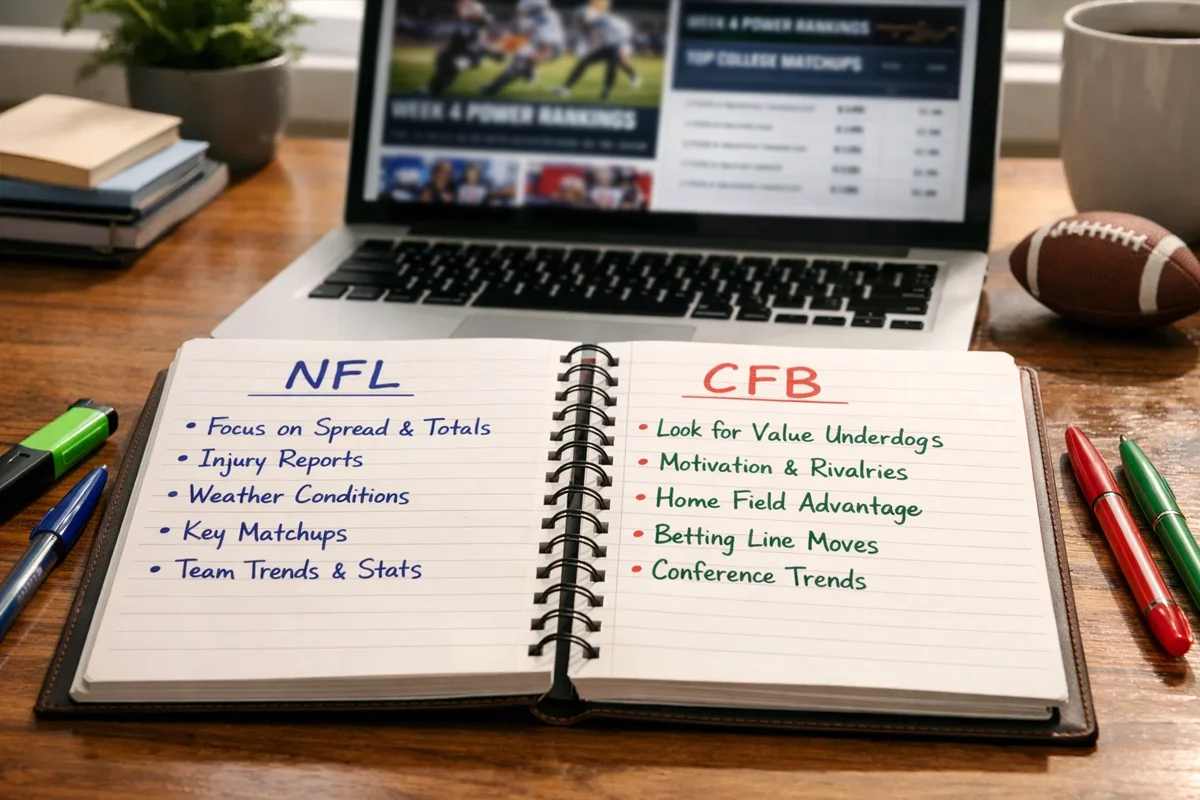
Optimal betting strategies differ between NFL and college football. Approaches that work in one market may fail in the other.
NFL-Specific Strategies
In the NFL, focus on closing line value as your primary success metric. If you consistently bet lines that move in your direction, you are likely finding genuine edges. If you consistently take worse numbers than the closing line, your selection process needs refinement.
Situational handicapping matters in the NFL. Teams on short rest underperform. Teams in lookahead spots before major games can be flat. Divisional games late in seasons carry playoff implications that affect motivation. These patterns are priced into lines but not always perfectly.
Contrarian betting against public favorites has shown modest historical profitability in the NFL. The public loves betting popular teams and overs. Fading extreme public positions occasionally provides value, though the edge is small and requires discipline.
College-Specific Strategies
In college football, specialize in specific conferences or team subsets. Deep knowledge of one conference beats shallow knowledge of all conferences. You cannot watch and analyze 60 games per Saturday, but you can know everything about the 8-10 games in your conference of focus.
Early season betting offers unique opportunities. Preseason lines are based on projections that often miss badly. Teams that return more production than expected or have significant roster upgrades through transfers can be undervalued. Track returning production metrics to identify these situations.
Fade public perception of name-brand programs that have declined. Traditional powers like Nebraska or USC (in certain years) attract public money based on historical reputation rather than current team quality. When these programs are overvalued, their opponents offer value.
Combining Both Markets
Betting both NFL and college football diversifies your action across different market structures. A bettor struggling in the NFL’s efficient market might find more success in college football’s noisier environment. Conversely, someone overwhelmed by college football’s volume might prefer the NFL’s focused schedule.
Bankroll management should account for the different variance profiles. College football’s larger spreads and less efficient markets create higher variance outcomes. NFL betting tends to produce steadier results over time. Adjust your unit sizing if you find one market producing more volatile results than the other.
Time management matters when betting both. NFL requires focused effort on fewer games. College football requires triaging which games deserve deep research versus which should be skipped. Develop a weekly routine that allocates appropriate time to each without burning out.
Legal Considerations
Sports betting legality varies by state, and some states impose specific restrictions on college sports betting that do not apply to professional leagues.
State Restrictions on College Betting
Several states prohibit betting on in-state college teams or on college sports entirely. New Jersey initially banned betting on New Jersey college teams and college events held in the state. Some states allow college betting but restrict certain bet types.
These restrictions aim to protect amateur athletes and academic integrity. Whether they achieve those goals is debatable, but the rules exist and bettors must follow them. Check your state’s specific regulations before betting college football. Sportsbook apps use geolocation and will block prohibited bets automatically, but understanding the rules prevents confusion.
Prop Bet Limitations
Player prop bets face restrictions in college football that do not apply to NFL betting. Many states prohibit individual player props on college games, allowing only game-level bets like spreads, moneylines, and totals. The concern is that individual player props create incentives for point-shaving or performance manipulation by amateur athletes.
Where college player props are available, the markets are thinner and less efficient than NFL equivalents. Fewer people bet them, so lines may be softer. But the restrictions limit availability significantly compared to the robust NFL player prop market.
These limitations affect betting strategy. If your edge comes from player prop analysis, the NFL offers more opportunity than college football. If you focus on game-level betting, the restrictions matter less.
Conclusion
NFL and college football betting require different approaches because the underlying markets differ fundamentally. The NFL is efficient, data-rich, and dominated by sharp money. College football is noisier, more variable, and offers pockets of inefficiency for prepared bettors.
Success in NFL betting comes from processing abundant information better than the consensus, finding situational edges, and consistently beating closing lines. Success in college football betting comes from specialization, early-season identification of mispriced teams, and exploiting games that escape sharp attention.
The best football bettors do not choose one market over the other. They understand both, apply appropriate strategies to each, and move their action to wherever they find the best opportunities. The differences between NFL and college football are not obstacles; they are features that create varied paths to profitability for those who take the time to understand them.
Whether you prefer Saturday NCAA action or Sunday NFL games, Bet Football Expert provides the insights you need to win.
